


|
|
|
|
The Integrated Services Digital Network (ISDN) is becoming a mainstream telecommunications network that will serves a wide variety of users' needs. Experts call ISDN the telecommunications network of the 21st century, the foundation upon which to further build the information age. With its narrowband and broadband aspects, the ISDN data highway will evolve from today's switched telephone and dedicated leased-line networks to become a unified global network carrying voice, data, video, interactive pictures, and other services to homes and businesses.
This network technology is becoming more available on a global scale and is providing a highly reliable and flexible infrastructure that can support high-bandwidth applications and a variety of services. Asynchronous Transfer Mode (ATM) switching technology, which is the basis for broadband ISDN, will be ideal for carrying various types of multimedia traffic in the next few years. Today, switched services and narrowband ISDN represent the first steps in the move toward digitized information.
Narrowband ISDN as a means of switched WAN access in data networks is an attractive solution for branch or satellite locations, small businesses, or home offices because of the reliability that is inherent in its digital nature, its fast call setup (needed to support routing protocols), its flexibility in supporting different services, and its ability to support existing WAN protocols such as Frame Relay and X.25. ISDN provides a migration path for remote sites and individual remote users to meet the bandwidth demands of critical applications today and to evolve to higher speeds as needs change in the future.
This paper presents an overview of narrowband ISDN technology from a data networking perspective and reports on its current deployment status worldwide. It compares ISDN with other existing and developing WAN services, covering point-to-point and switched, private, and public services. Next it looks at how ISDN addresses the growing need for remote LAN-to-LAN, remote node-to-LAN, and Internet and on-line information access connectivity. Finally, the paper provides information on ISDN planning and cost of ownership. An ISDN glossary and a list of 3Com ISDN products for central sites, remote sites, and individual user environments are included at the end of the paper.
The Integrated Services Digital Network (ISDN) is a currently available and growing public telecommunications network with a flexible infrastructure designed to integrate voice, data, video, images, and other applications and services. ISDN can be thought of as a replacement for the existing analog telephone network. Narrowband ISDN provides lower-speed services, from 56 Kbps to 2.0 Mbps; while broadband ISDN, based on the evolving cell-based Asynchronous Transfer Mode (ATM) technology, addresses high-speed service needs, from 2 to 600 Mbps.
With ISDN, smaller regional and international sites can connect to enterprise networks and to one another much more cost-effectively than with dedicated leased lines. Dial-up ISDN links can replace leased-line connections altogether or be used as supplemental bandwidth for overflow and redundancy. Remote sites and individual remote users can dial in to central networks worldwide and enjoy reliable, high-speed digital connectivity to critical resources, or access and download the ever-increasing wealth of multimedia information on the Internet.
ISDN combines the coverage of a geographically extensive telephone network with the data-carrying capacity of digital data networks into a well-defined structure that can support simultaneous voice, data, video, imaging, and multimedia applications.
ISDN technology has been available for years, but only in the past year have tariffs and deployment reached the point where it has become an affordable and viable WAN option, particularly in North America. In most of Europe and Japan, deployment is widespread; however, ISDN availability is just over the 70 percent mark in North America. ISDN is available in most North American metropolitan areas, while more rural regions still do not have access.
Tariffing, as with any public service, has a large political/bureaucratic component. In North America, a Basic Rate Interface (BRI) is the most commonly used ISDN line and generally costs slightly more than a POTS (plain old telephone service) line. Service charges are slightly higher, but because less time is spent on-line, usage costs are lower. Given the advantages of a digital network, ISDN can be a cost-effective alternative to analog services. In some European countries, a Primary Rate Interface (PRI) access line is more affordable than BRI service.
ISDN offers many benefits for organizations where data applications use public switched telephone network facilities. These benefits make ISDN particularly attractive for small regional and international branch sites that need to connect to central enterprise networks and to one another.
Data call connection with ISDN takes about one to four seconds to establish, while a Switched 56 or analog modem connection can take as long as 40 seconds. Fast call setup enables data applications to establish a connection on demand, transfer data, and disconnect, thereby minimizing usage charges. ISDN can also support concurrent voice, data, and video applications, whereas other switched digital services are designed to support only data.
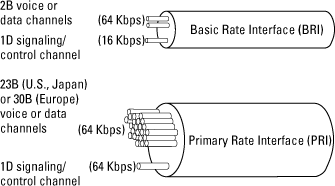
The ITU-TSS has defined two ISDN user interface standards (shown in Figure 1):
Figure 1. BRI and PRI User/Network Interfaces
Terminal adapters employ two common rate adaption protocols to handle the transition. In Europe, V.110 is the most popular rate-adaption protocol, while North American equipment manufacturers use the newer V.120 protocol. Both standards support both synchronous and asynchronous transmission.
Rate adaption also comes into play when access to 64 Kbps circuits is not available from one end of a connection to another. Since ISDN is currently not ubiquitous worldwide, telephone providers must sometimes create an end-to-end digital connection using Switched 56 Kbps digital services, even though the call originated on an ISDN link. In this case, the effective throughput of the link is limited to 56 Kbps. This type of rate adaption commonly occurs on international calls originating in North America or on calls that pass through multiple telephone carrier service areas. Most ISDN terminal equipment adjusts transparently to the lower rate.
Also known as bandwidth-on-demand or inverse multiplexing, channel aggregation is often abbreviated as Nx64 Kbps, where N stands for the number of channels logically combined. In practice, network managers can adjust the inbound or outbound calling flow to respond to time-of-day or day-of-week needs. For example, a network manager could combine a number of channels to support a full-color, full-motion video conference during a busy weekday morning, and arrange to combine channels after workday hours for high-speed file transfers to remote sites anywhere.
The competing proposal for providing this functionality is called BONDing, which approaches synchronization between multiple streams at the bit level. BONDing was designed for video conferencing applications and will most likely require additional hardware for the end system. Because BONDing is hardware-oriented, it is efficient; but it is also expensive and inflexible, since once a pipe size is set, it cannot be changed until the session is finished. BONDing has been adopted more readily in the videoconferencing arena than in data networking.
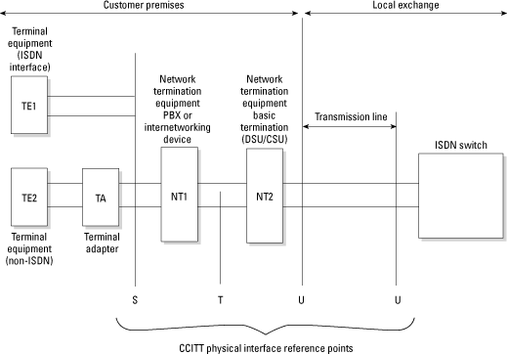
The following list shows the different types of functional devices that connect a customer site to ISDN services at the telephone carrier central office, as well as the ITU-TSS-defined interfaces that link them to network services (see Figure 2). Equipment that complies with these ITU-TSS-defined interfaces is guaranteed to be compatible with both ISDN and the other functional devices connecting to ISDN from the customer premises.
There are two types of terminal equipment (TE): devices with a built-in ISDN interface, known as TE1, and devices without native ISDN support, known as TE2. Terminal equipment consists of devices that use ISDN to transfer information, such as a computer, a telephone, a facsimile machine, or a videoconferencing machine.
Terminal adapters (TAs) translate signaling from non-ISDN TE2 devices into a format compatible with ISDN. TAs are usually stand-alone physical devices.
The S interface is a four-wire interface that connects terminal equipment to a customer switching device, such as a PBX, for distances up to 590 meters. The S interface can act as a passive bus to support up to eight TE devices bridged on the same wiring. In this arrangement, each B channel is allocated to a specific TE for the duration of the call.
Devices that handle on-premises switching, multiplexing, or ISDN concentration, such as PBXs or switching hubs, qualify as NT2 devices. ISDN PRI can connect to the customer premises directly through an NT2 device, while ISDN BRI requires a different type of termination.
The T interface is a four-wire interface that connects customer site NT2 switching equipment and the local loop termination (NT1).
An NT1 is a device that physically connects the customer site to the telephone company local loop. For PRI access, the NT1 is a CSU/DSU device, while for BRI access the device is simply called by its reference name, NT1. It provides a four-wire connection to the customer site and a two-wire connection to the network. In Europe, the NT1 is owned by the telecommunications carrier and considered part of the network. In North America, the NT1 is located on the customer premises.
The U interface is a two-wire interface to the local or long-distance telephone central office. It can also connect terminal equipment to PBXs to support distances up to 3000 meters. The U interface is currently not supported outside North America.
Figure 2. ISDN Functional Devices and Physical Interfaces
BACP manages bandwidth by allowing two peers (both of which support BACP) to negotiate the addition or deletion of a link in a multilink bundle. These links could be voice or data channels in an ISDN line. While not limited to ISDN, BACP is especially useful in ISDN environments because ISDN is a high-speed medium that uses multiple channels. With BACP, large hunt groups over multiple channels are easy to manage.
The benefits BACP offers are network flexibility, multivendor product interoperability, the ability to manipulate bandwidth to maximize network resources, and the ability for either end of a connection to manage the link, reducing operating costs.
For remote users in Europe and the Pacific Rim, where the ISDN infrastructure is more mature, ISDN has supplanted analog lines for remote node-to-LAN connectivity. Current ISDN installation in Europe is estimated at two million lines, and in Japan, more than 850,000 lines. The Japanese telecommunications giant NTT has committed to having 97 percent deployment by 1997. The stumbling block for these remote users has been the availability at the central site of ISDN-capable remote access servers, which are required for high-performance access to central site LAN resources. However, remote access servers that support ISDN are becoming more available worldwide.
According to Dataquest, ISDN connections in the United States increased 81 percent from 1994 to 1995--from 247,000 to 448,000 BRI lines. Dataquest predicts that ISDN installations will increase another 69 percent this year, from 448,000 to 758,000 BRI connections. ISDN deployment in the U.S. varies widely among RBOCs and local exchange carriers (LECs). Although some carriers such as Pacific Bell and Bell Atlantic Corporation have upgraded more than 80 percent of their switches to ISDN technology, other carriers have as few as 46 percent of their switches upgraded. Figure 4 on shows the current and projected growth of average ISDN deployment by U.S.-based LECs.
ISDN availability in Canada is much like that in the U.S. The service is predominately available in metropolitan areas through a variety of service providers, including members of the Canadian consortium, Stentor.
Figure 3. Worldwide Installed ISDN Circuits
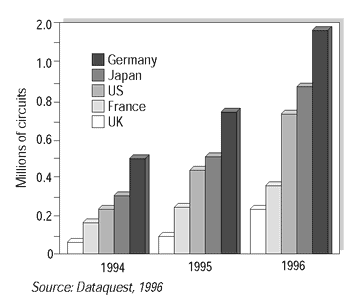
Figure 4. ISDN Switching Deployment Among U.S. Carriers
Some of these technologies and services are normally only cost-effective with larger site LAN-to-LAN connectivity applications. In contrast, ISDN is a viable option for both large and small remote LAN-to-LAN and remote node-to-LAN applications, as well as for Internet and on-line service access. This section compares the most common WAN data communication service options with ISDN. Choosing the best option involves evaluating such factors as service availability in locations requiring connectivity, types of network applications to be supported, and the internetworking environment. Table 2 on compares the types, line speeds, applications, and relative strengths and weaknesses of common WAN services.
In most cases, analog dial-up service providers will not guarantee support for specific data rates even if users purchase analog modems capable of handling up to 28.8 Kbps transmission rates; the maximum data rate is typically 19.2 Kbps. Little or no diagnostics are available from the service provider other than normal testing performed on residential and business lines. Also, line quality varies widely, and the amount of noise on a line has a direct bearing on the maximum data transmission rate.
Table 2. (Part 1) WAN Services Comparison
| Analog Dial-Up | Switched 56 | X.25 | Point-to-Point Leased Lines | Frame Relay | |
| Type | Circuit switched, public | Circuit switched, digital, private | Packet switched, public or private | Point-to-point, private | Packet switched, public or private |
| Bandwidth | 64 Kbps voice 9.6-28.8 Kbps data (14.4 Kbps typical) | 56 Kbps data | 56 Kbps data | T1/E1: 1.544 Mbps data (N.A.); 2.048 Mbps data (Europe) T3/E3: 45 Mbps (N.A.); 34 Mbps (Europe) | 64 Kbps-1.544 Mbps data |
| Applications | Voice and data on separate lines | Voice and data on separate lines | Protocol for terminal -to-host | High-speed voice and data transmission for transaction based environment applications and Internet access | Optimized for data data transmission Point-to-point environments |
| # of Sites for Cost- Effectiveness | Unlimited | Unlimited | Unlimited | Few | Private leased line replacement; cost-effective for fewer fixed sites |
| Strengths | Wide availability, any-to-any connectivity, low cost | Wide availability, any-to-any connectivity, moderate cost, uses standard telephone numbers, interoperates with ISDN | Wide availability, efficient for bursty traffic, any-to-any connectivity, automatic error detection and correction, security, standardized protocols | High speed; high degree of management, reliability, and security; standardized; direct connections to Internet | High speed, low latency, bandwidth- on-demand. easy scalability, standardized protocols, point-to-point connectivity |
| Weaknesses | Limited bandwidth, no efficiency gain supporting bursty versus continuous traffic, lacks multi-vendor management | Data only, limited bandwidth relative to ISDN, service providers de- emphasizing it, requires CSU/DSU equipment | Limited bandwidth since error detection limits speeds, increases cost; marginal for LAN inter- connection | Fully meshed topologies very expensive | Expensive (compared to ISDN), requires a dedicated access line, not widely deployed in capabilities Europe, expensive and complicated to make moves and changes |
| Pricing Elements | Installation (varies); average monthly charge plus usage charge | Installation (varies); average monthly charge plus usage charges | Installation (varies); average monthly charge, free usage charge up to ceiling | Installation (varies); flat rate based on bandwidth and distance | Installation (varies); typically flat rate options, some carriers offer usage options |
Table 2. (Part 2) WAN Services Comparison
| xDSL | Cable | SMDS | ISDN | ATM (Broadband ISDN) | |
| Type | Circuit mode | Point-to-point, private | Cell switched, public | Packet/circuit switched, public | Cell switched, public switching technology |
| Bandwidth | 64 Kbps-52 Mbps (varies by technology) | 500 Kbps-30 Mbps data and video | Nx56/64 Kbps data (or packet voice or video) (1.544-45 Mbps typical) | 64-128 Kbps for BRI voice, video, and data 1.544-2.0 Mbps for PRI voice, video, and data | 1.544 Mbps-622 Mbps voice, video, and data (25-155 Mbps typical) |
| Applications | Data dialtone (Internet access, remote LAN access), video dialtone (video conference, video on demand) | Consumer, on-line Internet and information access, LAN connections, video | Optimized for data Multipoint environment | Optimized for voice, data, and video integrated on a single digital line | Optimized for switching voice, data, video Switching , multiplexing technology |
| # of Sites for Cost- Effectiveness | Unlimited, but local access service only | Unlimited | Cost-effective for four or more sites | Unlimited | Power users, early adopters; initially LAN only backbone applications |
| Strengths | Broadband bandwidth, simultaneous digital services and lifeline POTS, dedicated (not shared), supports multimedia service | High speed, existing infrastructure, fast call setup | High speed, low latency, any-to-any connectivity, economical for virtual meshed networks, standardized protocols, easy to make changes | High speed; digital data, voice, images, video on integrated line; fast call setup; secure, reliable, stable digital connectivity; efficient for bursty traffic; standardized protocols | Very high-speed; data, voice, images, video on integrated line; fast call setup; secure, reliable, stable digital connectivity; efficient for bursty traffic |
| Weaknesses | Standards and infra-structure still under development, service area distance limitations, degree of data transport symmetry varies | Developmental stage only, voice on separate line, bandwidth split among users with no firewall capability, historically weak customer service and support, mostly one-way transmission | Not widely used in N.A., Europe, or Pacific Rim | Not yet ubiquitous, tariff rates inconsistent, can be complicated to install and configure | Not yet widely available; standard- ization details still under development, current products expensive, proprietary products have multi-vendor compatibility problems due to lack of standards |
| Pricing Elements | TBD | Installation (varies); average monthly charge plus usage charge | Installation (varies); usage and flat-rate options charge | Installation (varies); average monthly plus usage charge (varies) | Customer- by-customer basis |
X.25's packet-switching technology automatically allocates access to available bandwidth and efficiently handles the bursty traffic inherent in LAN environments. X.25 also provides data security and automatic error detection and correction facilities, although the in-band facilities consume valuable data transmission bandwidth. However, X.25's slow speed prevents it from being an effective medium for higher-speed LAN or WAN applications.
For locations transferring controlled amounts of steady data traffic, leased 56- and 64-Kbps lines are popular because of their low installation and monthly rental charges. Private dedicated lines do not provide any inherent efficiencies in transmitting bursty traffic and are often underutilized, sometimes running at only 5 to 20 percent of total capacity. In addition, point-to-point, fully redundant interconnectivity requires expensive mesh topologies and customer premises equipment.
Fractional T1 (E1 in Europe) is a high-capacity, private digital service designed to support multiple 64 Kbps channels. With this service, WAN subscribers can lease one of several 64 Kbps channels instead of the full T1 pipe. The service offers the same control, management, and security features as the full T1, and the same disadvantages, although costs are lower for fully meshed topologies.
When data traffic between remote sites is intermittent or infrequent, ISDN and other switched services can be a cost-effective and reliable alternative to leased lines.
Used in a remote communications path for an enterprise network, Frame Relay is totally transparent to users. Frame Relay technology uses standard WAN interfaces and CSU/DSUs and can coexist easily with ISDN and ATM services. The disadvantages of Frame Relay are that it can be as much as 12 times more expensive than ISDN and it requires a dedicated access line. Like SMDS, it is not yet widely deployed in Europe or in Asia and the Pacific Rim.
Cable data networks are being designed to eliminate the lengthy dial-up and sign-on process inherent in analog services. The cable access device includes modem technology to convert the analog signal into digital data used by the computer. The network pipe itself is increasingly a fiber optic or hybrid fiber-coaxial cable designed for two-way communication in an asymmetric configuration. Data is carried downstream to the user over wide electromagnetic bands, while smaller bands carry commands and responses upstream to the cable provider's head-end.
The disadvantages of existing cable networks are their reputation for unreliable service and the fact that bandwidth is shared; if one user ties up the WAN link with a high-bandwidth application, other users suffer. Cable companies are currently designing distributed network models that would connect smaller groups of users to multiple points of presence to solve this problem. Furthermore, unlike ISDN, cable networks are not currently optimized for two-way data communications (versus one-way broadcast transmission). ISDN is standardized worldwide, whereas cable addressing schemes and other internetworking standards have not yet been developed. The cable standardization process could take several years; ISDN is a standardized offering now.
SMDS's connectionless nature eliminates the need for carrier switches to establish a call connection between two points before data transmission. SMDS access devices pass 53 byte datagrams that include addressing information to a carrier switch that forwards the cells over any available path to their destination. Data travels over the least congested routes in an SMDS network, providing faster transmission, security, and greater flexibility to add or drop network sites.
Between 200 and 500 customers in North America are using the service. In Europe and the Pacific Rim, service is just beginning to be deployed in about 16 countries. Internationally, SMDS is sometimes referred to as CBDS (Connectionless Broadband Data Service).
ATM has some of the advantages of narrowband BRI and PRI ISDN, with the significant added advantage of almost unlimited transmission speeds. However, many details of the ATM standard implementation are still evolving, and ATM WAN service is not yet widely available.
1.Define the set of WAN service alternatives and the associated cost elements to be compared:
2.Compare the alternatives using a specified measure of the relative worth or value of each factor; for example:
3.Define the planning horizon--the window for which the economic performance of each WAN service alternative will be viewed.
4.Develop a cash flow profile comparing expenditures using existing networking methods and expenditures with the potential new methods.
5.Select the preferred alternative after evaluating all of the weighted cost-value factors.
6.Communicate your findings to upper management in business and financial terms that can be understood and accepted.
ISDN's high throughput capacity with dynamic bandwidth allocation features, signal quality, reliability, flexibility, fast call setup, and attractive tariffs make ISDN an excellent, cost-effective medium for the following major networking applications:
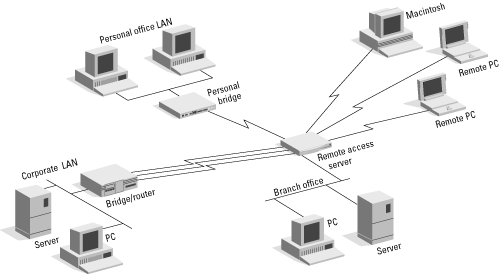
These smaller remote sites might also require dial-up access to central site network resources just for individual users. In either case, exchanging e-mail or retrieving information from central computers requires at least a temporary WAN connection.
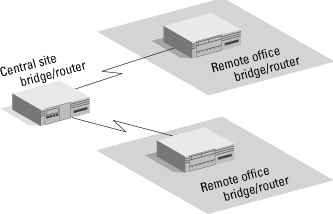
ISDN and other switched services are well suited for on-demand remote LAN-to-LAN configurations since they provide a telephone circuit only when information needs to be transferred. And some internetworking devices have the intelligence to schedule these connections when telephone rates are more economical, for added cost savings.
Figure 5. Remote LAN-to-LAN Internetworking
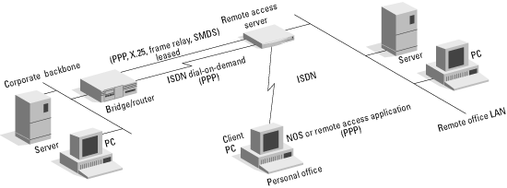
With ISDN's fast call setup capability, remote LAN-to-LAN or remote node-to-LAN access can take advantage of dial-on-demand during an individual session. When there is no client data traffic destined for the LAN, the client can disconnect an ISDN WAN link transparently to the running application to save dial-up charges. The application continues to see a logical link to the LAN through a process known as "spoofing." When communication with the LAN is required, the remote client automatically reestablishes a dial-up session and passes the data traffic over the WAN.
Figure 6. Dial-on-Demand Internetworking Application
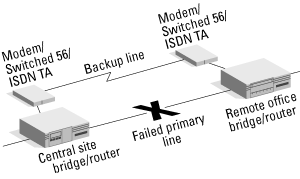
A dial-up connection, such as an ISDN BRI line, is a more affordable back-up solution to a primary leased line. As shown in Figure 7, the dial-up line is automatically activated by the central internetworking device when a failure occurs on the primary line, with no apparent degradation of service in the network. If the primary line is a high-speed pipe running at T1 or E1 rates, several lower-speed dial-up circuits can be aggregated to achieve comparable high-bandwidth capacity.
ISDN can also be used to carry the overflow of data connections when the data load increases. When the primary line reaches maximum capacity, the bridge or router can detect the bandwidth bottleneck, dial one or more ISDN circuits in real time, and route overflow traffic through the B channels.
Figure 7. Redundant WAN Link Internetworking Application
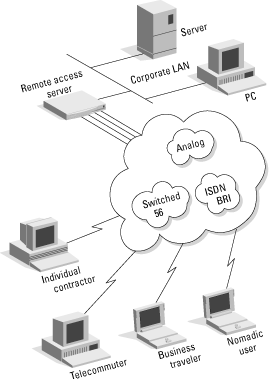
Remote node-to-LAN internetworking opens new avenues of communication for employees who travel extensively, work at home, or require after-hours access to the office. At the central site, the internetworking device receives incoming data calls from various locations through pools of dial-in lines, provides security authentication and validation of callers via login procedures, and routes the calls over the central site network. Alternatively, the internetworking device can hang up after identifying the caller and call back later for security or economy. With ISDN, remote and mobile computer users can get secure and reliable access to multiprotocol LANs and SNA mainframe resources.
ISDN's fast call setup is ideal for the point-of-sale transaction-based networks of small businesses and retailers that need immediate responses to credit and debit card authorization, and for medical center and other health-care providers that need immediate verification of health-care eligibility. Using ISDN, the verification process typically takes less than one second compared to the 15 second or more wait experienced with 14.4 Kbps analog modem-based systems. ISDN's high speed and rapid response times offer a competitive advantage in responsive customer service.
Figure 8. Remote Node-to-LAN Internetworking Application
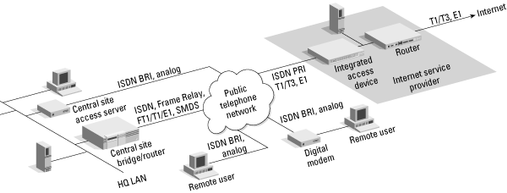
As shown in Figure 9, ISDN's high-speed service solves the bandwidth access problems for these remote users, as well as for Internet users on an enterprise LAN. Remote users can connect to the Internet directly or dial in to the central site access server and gain access to the Internet through the central site LAN, taking advantage of its faster link to the Internet service provider. More and more public and private Internet service providers are tapping this market and supporting ISDN gateways that provide 64- and Nx64-Kbps access to the Internet or other on-line information access services.
Figure 9. Internet Access Internetworking Application
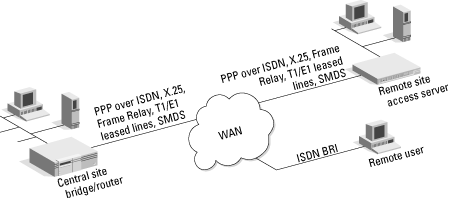
As Figure 10 shows, client-to-LAN applications such as remote node-to-LAN internetworking are point-to-point applications. LAN protocols such as IP and IPX, transmitted from a client application or network operating system, are transported over the dial-up ISDN link using the Point-to-Point Protocol (PPP) or Multilink PPP (ML-PPP).
Once the data packet reaches the LAN, the remote access server can route it as is using PPP, or repackage the data and route it over the backbone using any available network service, including X.25, Frame Relay, or SMDS. The service is entirely transparent to the B channel. The remote access server can also establish a LAN-to-LAN connection on demand via a dial-up link, and route the data packet using PPP or ML-PPP.
Figure 10. ISDN Access to Other WAN Services
Residential and small-site users will need some of the following special equipment to access ISDN lines:
| 3Com Product Name | Functional Description | 3Com IOC |
| NETBuilder II® router | Provides the central site LAN ISDN connection for remote site with WAN Extender internetworking. Includes two PRI ports and one channelized T1/E1 connection to support both ISDN and analog lines. | Not applicable |
| SuperStack(TM) II NETBuilder® ISDN router | Provides the remote site LAN-to-ISDN connection for remote site internetworking. Includes one BRI port and one LAN connection. | Capability R |
| AccessBuilder® 8000 integrated remote access system | Provides the interface between the public switched telephone network and data networks. A software-defined network access platform that installs in the central office of telcos and Internet service providers. | Not applicable |
| AccessBuilder 7000 remote access concentrator | Provides high-bandwidth connectivity using a combination of BRI and PRI ISDN, leased line (WAN), and analog connections (for BRI) in a chassis-based system designed for remote LAN access and central site connectivity. | 3ComA * J6 |
| AccessBuilder 4000 remote access server ISDN BRI module | Provides the central LAN site ISDN connection for telecommuter and mobile users or for small site remote node-to-LAN internetworking. | 3ComA * J6 |
| AccessBuilder Remote Office 700 ISDN bridge/router | Provides LAN connectivity for TCP/IP and IPX over ISDN or leased lines. Includes two serial ports with optional third and fourth ports, and one ISDN PRI port. Operated over fractional ISDN primary rate services. (Not available in North America.) | Not applicable |
| AccessBuilder Remote Office 600 ISDN bridge/router | Provides LAN connectivity for TCP/IP and IPX over ISDN and leased lines in a LAN-to-LAN environment. Includes two high-speed serial ports and ISDN BRI port and optional second ISDN BRI port. | 3ComA * J6 |
| AccessBuilder Remote Office 500 ISDN bridge/router | Provides LAN connectivity for TCP/IP and IPX over ISDN or leased lines. Includes a serial port, ISDN BRI port, and an analog port. | 3ComA * J6 |
| AccessBuilder Remote User 400 ISDN bridge/router | Provides LAN connectivity for TCP/IP and IPX over ISDN lines with an ISDN BRI port. | 3ComA * J6 |
| OfficeConnect(TM) Remote 530 ISDN bridge/router | Member of the OfficeConnect family providing LAN connectivity for TCP/IP and IPX over ISDN or leased lines. Includes a serial port, ISDN BRI port, and an analog port. | 3ComA * J6 |
| OfficeConnect Remote 520 ISDN bridge/router | Member of the OfficeConnect family providing LAN connectivity for TCP/IP and IPX over ISDN lines. Includes an ISDN BRI port and an analog port. | 3ComA * J6 |
| OfficeConnect Remote 510 ISDN bridge/router | Member of the OfficeConnect family providing LAN connectivity for TCP/IP and IPX over ISDN lines with an ISDN BRI port. | 3ComA * J6 |
| OfficeConnect gateway 535 | Member of the OfficeConnect family providing Novell IPX net- works using Ethernet with a gateway to the Internet over ISDN or WAN/leased lines. Includes a serial port, an ISDN BRI port, and an analog port. | 3ComA * J6 |
| 3ComImpact(TM) IQ external ISDN modem* | Provides ISDN BRI services for PC and Macintosh® users to access the Internet and corporate intranets | Package K with two telephone numbers. Package M with fax call offering. Package U. In Bell South territory, specify EZ ISDN 1. |
| *Available in the U.S. and Canada only. | ||
The ISDN ordering codes are a standardized list of network services associated with specific U.S.-based ISDN customer premises equipment for a specific application. Seventeen standard capabilities were defined based on the most popular network configurations -- combinations of features, services, and network parameters--already in use by thousands of ISDN customers across the country. To date, more than ten international service providers and over 40 CPE vendors support ISDN ordering codes.
Specifying the CPE vendor's equipment ISDN ordering code when placing an order with an ISDN service provider circumvents line provisioning or other complexities. The standard code ensures that the line will work properly with the equipment and will be provisioned more quickly and accurately. A vendor should be able to provide the IOCs for its products to its U.S.-based ISDN users. Bellcore alerts carriers to the products and switch translations these IOCs represent.
The North American ISDN User's Forum (NIUF) Ad Hoc Group on the Simplification of ISDN Ordering, Provisioning, and Installation has been focusing on developing easier ways for customers to order ISDN service. The EZ-ISDN codes that they have proposed reduce even further the number of IOCs and are geared toward assisting mass market users of ISDN.
A single BRI connection can link remote users or smaller sites to a central LAN site with simultaneous voice and data communication. Switched digital network access is particularly well adapted to users in remote locations who often cannot justify the cost of a dedicated connection to central site LANs. In addition, ISDN's high-speed capabilities make it a cost-effective option for organizational and residential users who want to take full advantage of the information-rich resources on the Internet and World Wide Web.
Evaluating WAN services for your enterprise network entails weighing the advantages, limitations, and cost of ownership of each option against your company's short- and long-term internetworking needs. ISDN provides some clear advantages for switched WAN access: the reliability and built-in security of digital technology, fast call setup for data applications, interoperability with other services such as Frame Relay and X.25, and cost-effective integrated support of voice, data, and video services on a call-by-call basis. ISDN also delivers the bandwidth demands of critical applications today, while providing a migration path to the higher speeds of broadband ISDN using ATM switching as application demands grow in the future.
Successful ISDN deployment involves identifying and understanding all service provisioning and equipment configuration and maintenance options, as well as other cost-of-ownership issues, in advance of implementation. Careful planning will ensure that your ISDN installation runs smoothly and that the network system you've implemented meets your organization's short-term and long-term WAN connectivity requirements.
Robyn is a board member of the Vendors' ISDN Association, is active in the California ISDN Users Group and the ATM Forum's Residential/Small Business sub-working group, and represents 3Com at xDSL standards organizations.
Robyn holds an M.B.A. in marketing and international business from New York University and an M.S. in information science and systems from the University of Illinois.
Najib Khouri-Haddad joined 3Com in 1992 as the product manager for remote office products in the network systems division. Today he is product line manager in the Primary Access division, managing the AccessBuilder 5000 and remote access server products. Previously Najib worked at Rolm, a business communications systems company.
Najib holds an M.A. in engineering management from Stanford University and an M.S. in electrical engineering and computer science from the University of Michigan.
For more information on 3Com's ISDN product offerings, contact your local 3Com representative by calling 1-800-NET-3COM. Outside the United States and Canada, call your nearest 3Com sales office.
 |
|
News/Events | Partners | Technology | Solutions | Products | Support | Inside 3Com Home | Log In | Search | Feedback | Site Map | Site Features | Document Center | Shop | Legal |