|
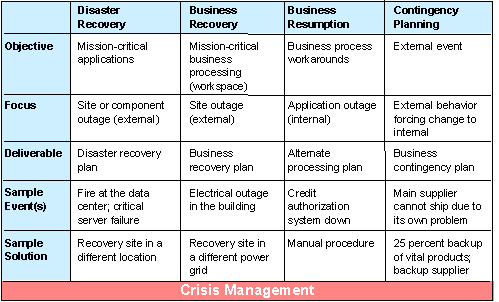
Source: Gartner Research
Crisis management is the enterprise's first response to an event that
could change the way business operations are normally conducted. A
well-managed approach to such an event will help significantly to ensure
that employees, customers, partners, investors and the general public
continue to have confidence in the financial viability of the
enterprise.
Gartner estimates that 85 percent of Global 2000 enterprises have
established a disaster recovery plan that addresses the recovery of their
core technology infrastructure, but only 15 percent have a full-fledged
business continuity plan covering all five critical components. This is
dangerous; enterprises must shift from a disaster recovery focus to
business continuity because most, if not all, stages of the business life
cycle now totally depend on IT services. BCP is vital to the maintenance
of public, customer and investor confidence.
E-commerce initiatives do not change the five components of BCP, nor do
external events impacting the normal business cycle. These factors simply
place more importance on the enterprise’s contingency and crisis
management plans because of the public nature of outages and the
increasing reliance on external services providers for processing. The
potential range of failures must be determined from an organizational
perspective, and all interdependencies must be planned for appropriately.
Each component of the business process must be addressed in the recovery
plan, and enterprises must perform an end-to-end analysis of the
information flow through internal and external processing environments to
successfully provide recovery options for all potential scenarios.
An Effective Crisis Management Team
The crisis management team is responsible for managing the event from
an enterprise perspective and covers the following major activities:
- Supporting personnel and their loved ones during the crisis
- Determining the event's impact on normal business operations and, if
necessary, making a disaster declaration
- Keeping the public informed about the event and the actions being
taken to ensure the recovery of personnel and the enterprise
- Communicating with major customers, suppliers, partners, regulatory
agencies, industry organizations, the media and other interested parties
An emergency response/damage assessment team should keep the crisis
management team apprised of the status of the event, focusing on the
damage it caused to normal business operations.The emergency
response/damage assessment team should consist of onsite personnel working
with the following entities:
- Local law enforcement and other officials (e.g., fire and police)
- Utilities (e.g., gas, electricity and telephone)
- Facilities management
A command center must be established from which the event can be
managed (until a disaster is officially declared or reentry to the regular
facility is possible). Enterprises should consider establishing a
“virtual” command center to limit the vulnerability caused by all senior
executives being in one location.
An effective crisis management team must have participation from:
- Senior management from each business unit
- Human resources
- Facilities/building management
- Risk management (operational, financial and IT)
- Legal/compliance
- Communications/public relations
- Chief information officer/chief technology officer
- Business continuity manager
Personnel Management and Notification
Personnel Head Count: If a disaster occurs during business
hours, the first response is usually to evacuate all personnel. A complete
head count must be conducted as soon as possible after evacuation.
Management should attempt to identify all personnel who have been injured,
including those who may be able to seek medical assistance on their own
(as they may become lost in the confusion, causing their families undue
concern). Management must keep a record of personnel who are offsite for
any reason — e.g., vacations, training, illness or business travel.
Personnel Contact Information and Call Tree: Because not all
disasters occur during business hours — and because not all personnel will
necessarily proceed immediately to the evacuation location — personnel
contact information is essential to management's efforts to reach and
account for all personnel. Management must document and regularly update a
broad range of contact information — including home, office, vacation home
and mobile telephone numbers, work and personal e-mail addresses, and
pager numbers — to ensure that many contact channels are available.
The establishment of a call tree — i.e., a list that defines who is
responsible for calling whom in the event of a disaster — makes contacting
personnel significantly easier. The call tree must be updated frequently
and following any change in organization, location or employee contact
information, and tested, at minimum, during testing of the business
continuity plan. Tests should be unplanned to ensure realistic results.
Enterprises may use automated services for call tree testing and for
implementation of the call tree during an actual disaster.
Emergency Information Card: An emergency information card will
remind all employees, consultants and contract workers of critical
information during and after the event. Typical components of an emergency
information card include:
- Immediate evacuation location: an address near the facility where
personnel will assemble immediately after the event so that a head count
can be taken and instructions given regarding the management of the
event
- Assembly location: an address where personnel not involved in the
recovery operations, but not immediately sent home, can be sheltered,
supported and given frequent updates on the event (depending on the
scope of the event, reentry to the building may be possible)
- Recovery location: the address of an alternate processing site where
business will be resumed after a disaster is declared
- Emergency hot line: typically, a toll-free telephone number that
personnel can use to receive and disseminate information
- Business continuity coordinator — the name, telephone number and
e-mail address of the person responsible for each department’s recovery
response
Balancing Personal and Enterprise Concerns: Many enterprises
developing crisis management plans are rightly concerned with finding ways
to enable their personnel to balance personal and family concerns in the
event of a disaster. Many of these enterprises have found that the
personal preparedness training offered by the American Red Cross is
useful. Information about these programs can be obtained at
www.redcross.org.
References
The following references may be of value to enterprises preparing
crisis management plans:
- "Emergency Planning Guide for Continuity Officials" (New York
publication, 1999)
- U.S. Federal Emergency Management Agency (FEMA) Web site —
www.fema.gov (includes a list of courses and workshops related to
emergency management)
- Federal Response Plan — April 1999 (FEMA document 9230.1-PL)
- Individual state emergency management agencies (often divisions of
the Department of Public Safety)
The underlying principle of effective BCP is preparedness: being ready
to deal with a disaster that may render the enterprise inoperable for some
time (typically, a minimum of 30 days). Preparedness requires that
management discuss all possible event scenarios and establish
well-planned, documented and tested procedures that will go into effect
when a disaster occurs. The worst possible time to make crisis management
decisions is during the disaster itself. |